Two-card reading
Use contrast without turning tarot into good versus bad
Two cards may differ in light, access, movement, scale, or mood. Contrast makes a decision visible, but it does not automatically label one side correct, predict a reversal, or promise that a closed gate will open.
Set the comparison before drawing
Choose positions that can hold difference without pretending to settle it: what protects / what permits, current assumption / overlooked option, or cost of staying / cost of moving. Avoid assigning “bad / good” as the two jobs. That frame builds the verdict into the spread before the images appear.
If the question concerns a high-stakes medical, legal, financial, or safety decision, use the pair only to clarify concerns and questions. Facts, qualified advice, consent, and risk assessment must lead the choice.
Build an axis of contrast from visible details
Describe both cards, then complete a neutral phrase: closed / open, night / day, near / distant, contained / exposed, still / moving, or one route / many routes. Choose the axis most relevant to the question rather than the most dramatic difference.
Do not assume that the card on the left is “before,” the one on the right is “after,” or that darkness is negative. Sequence comes from the declared spread positions. Cultural convention, the deck artist’s choices, and a reader’s own associations can all shape how light and enclosure feel.
Ask what each side makes possible
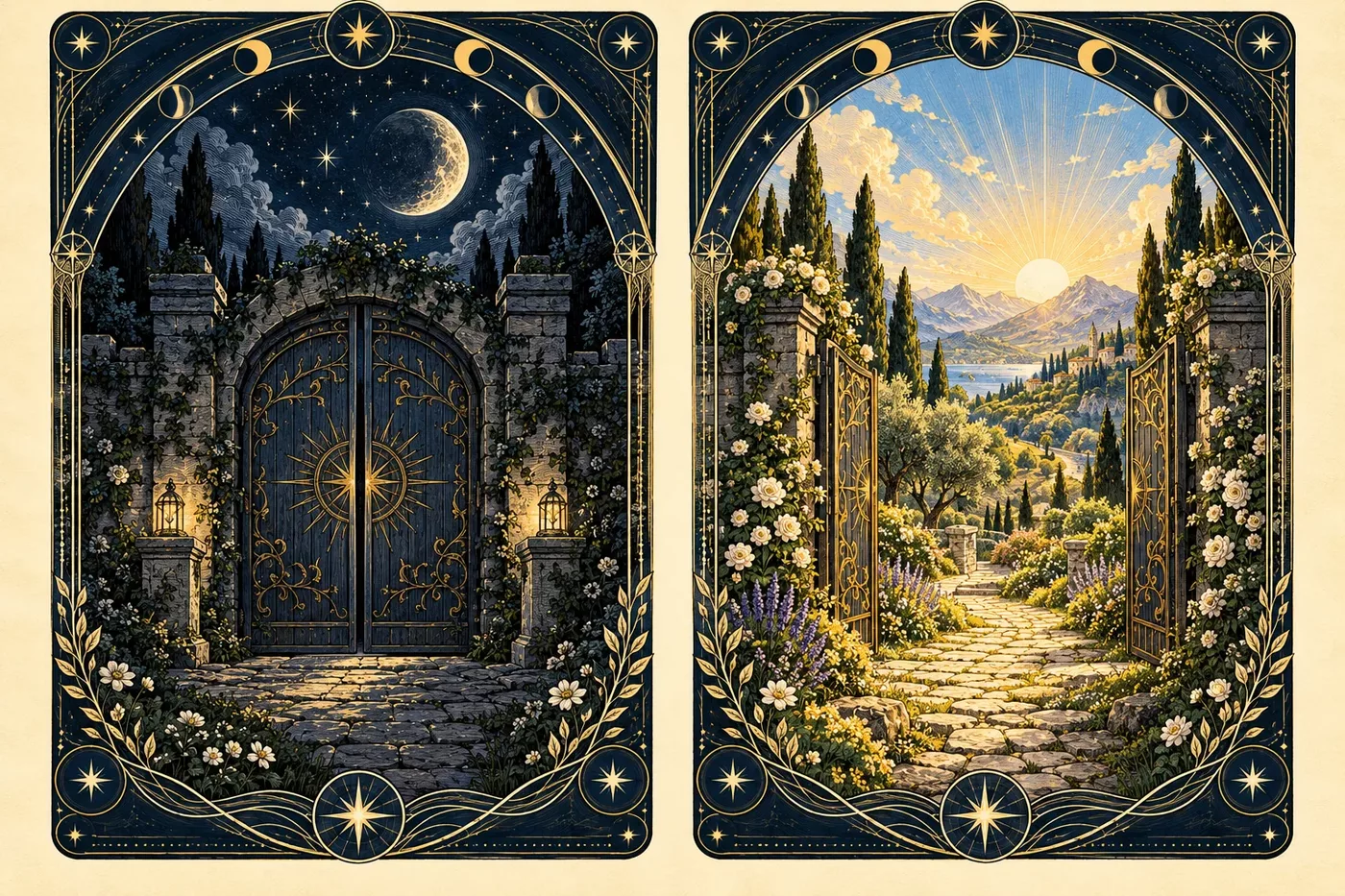
In the illustrated pair, the first gate is closed under moonlight; the second stands open toward a bright path. Under what protects / what permits, closure might represent a useful boundary while opening might represent access with greater exposure. Under current assumption / overlooked option, the same images might compare a conclusion that feels final with an alternative route not yet explored.
Neither reading is encoded permanently in the artwork. A closed gate may prevent harm, enforce exclusion, preserve privacy, or mark that more information is needed. An open gate may offer welcome, uncertainty, vulnerability, or work ahead. Keep at least two possibilities alive until the question and real-world evidence narrow them.
Read contrast in five passes
- Name the positions. Write them where you can see them.
- List observations. Record objects, actions, light, direction, distance, and boundaries without meanings.
- Select one axis. Choose the difference most connected to the question.
- Test two relationships. Try choice, tension, correction, boundary, or trade-off.
- Check reality. Ask what information would support or challenge the emerging interpretation.
Let contradiction remain when it is honest
Some pairs do not resolve into a tidy synthesis. One card may value privacy while the other values access; both needs can be real. Instead of choosing a winner, ask what condition would allow enough of each. Perhaps a conversation needs both a boundary on topic and an open invitation to return later.
Contrast can also expose a false binary. A gate need not be only locked or fully open; it can be opened for one person, at one time, with terms. Translate the symbolic opposition into more than two practical options.
Watch for projection and visual bias
Readers often reward brightness, symmetry, upward movement, or open landscapes before considering context. Notice that preference. Then argue briefly for the less favored image: what resource might it contain, and what risk might the favored image hide? This does not make every interpretation equally good; it makes the reasoning inspectable.
Close with a sentence that preserves choice: “The pair highlights a tension between…, and I will learn more by…”. If the sentence claims a certain event, names another person’s secret motive, or makes fear the only option, return to observation.