Describe before interpreting
How to observe palm line depth, faintness, and branches
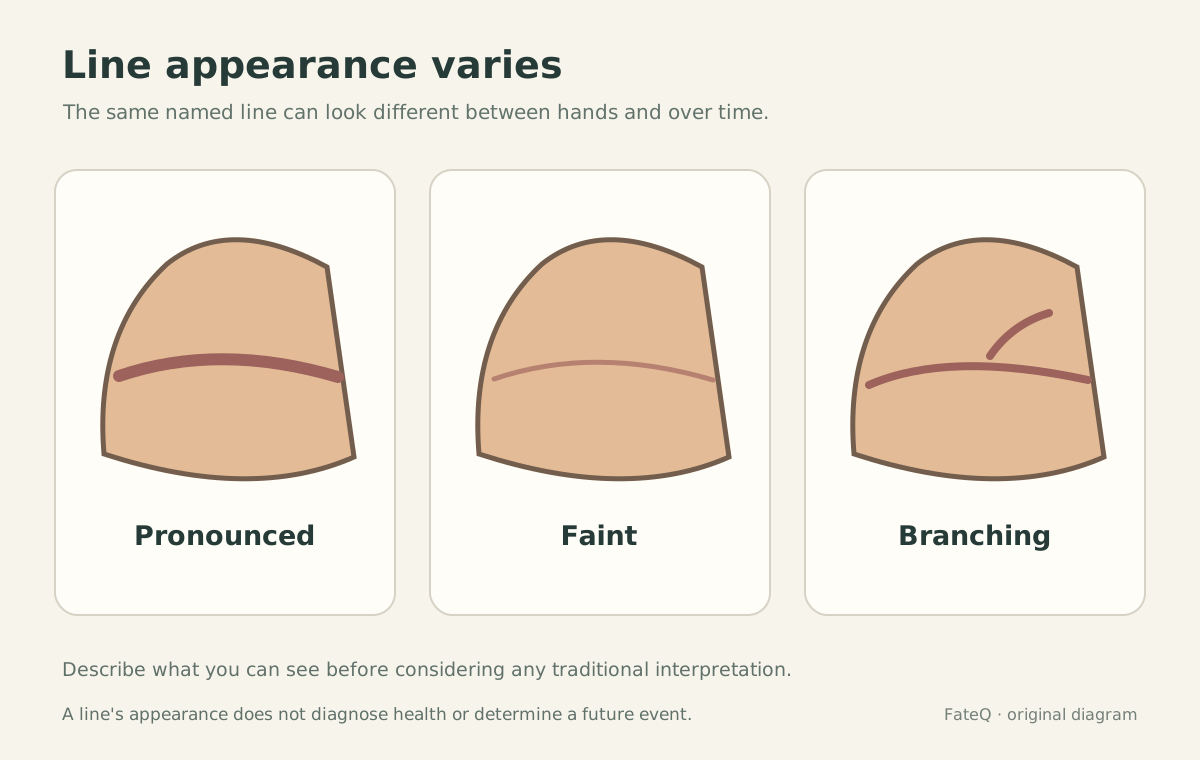
A line can appear pronounced in one segment, faint in another, or joined by smaller creases. Describe that appearance precisely before consulting any symbolic tradition—and never turn it into a diagnosis or forecast.
“Deep” is often an interpretation of appearance
Without touch or controlled imaging, a viewer usually sees contrast, width, shadow, and continuity—not measured physical depth. In a photograph, prefer pronounced or faint under this light to “deep” and “shallow.” This keeps the claim within what the image can support.
Check whether the whole line has the same appearance. A crease may be clear near its start and difficult to follow later. Record the change by location instead of giving the entire line one quality.
Follow the main route before naming a branch
Locate a major crease by its overall path and landmarks. Then follow it slowly from one end to the other. A smaller line is best called a branch only when it visibly joins that route; a nearby line may instead cross it, run beside it, or end before contact.
Use a simple vocabulary: branch for a joined offshoot, fork when one route divides, crossing when another crease passes through, parallel line when it runs alongside, and unclear when the connection cannot be seen. Everyday observation does not need an elaborate name for every mark.
Describe interruptions cautiously
A line that looks broken may be interrupted by faintness, glare, another crease, a scar, or the curve of the hand. Record the visible gap and its location. Do not announce a “break” in someone’s life, relationship, or health.
Look again with the palm relaxed and with the light moved across—not directly into—the crease. If the route still cannot be followed, leave the uncertainty intact. A confident false connection is less useful than an honest incomplete observation.
Use landmarks so another person can follow
“A small branch rises about halfway across the palm toward the space below the ring finger” is more reproducible than “a success branch appears.” Sketch the line, mark the palm edge and finger bases, and add an arrow to the detail. If photographing, keep an unmarked copy as well as an annotated version.
Formal anatomical studies distinguish major and minor creases and classify relationships, starting points, endings, branches, and variants. Their categories are designed for morphology, not for reading fate. Borrow the discipline of clear description without borrowing medical authority for symbolic claims.
Keep traditional meanings in a separate column
Palmistry manuals may associate a pronounced line with strength, a faint line with sensitivity or uncertainty, and branches with diversions or developments. These associations vary by author and by which named line is under discussion. They are traditions, not measurements of personality or future events.
If using them reflectively, write: “Some palmists associate this appearance with…” followed by an open question. For example, a visible branch might prompt, “Where are two priorities developing from the same commitment?” The hand does not prove that such a split exists; the person decides whether the question is useful.
Know what the line cannot tell you
No combination of depth, faintness, branches, islands, crosses, or breaks can determine illness, lifespan, pregnancy, wealth, honesty, or a specific future event. Changes in pain, skin, sensation, movement, or function are health concerns for a qualified professional, not material for divination.
A careful reading can still have value as visual attention and structured reflection. Its honesty comes from showing the boundary between the crease that is visible, the convention that is inherited, and the meaning a person chooses to explore.