Name the method
Feng shui basics: Form School and Compass traditions
If two feng shui guides disagree, they may be using different schools, calculations, or priorities. Naming the approach is more useful than pretending every rule is universal.
Feng shui is a family of traditions
Feng shui developed through multiple Chinese practices concerned with siting, landform, orientation, dwelling, and cosmology. The history is not a straight line from one ancient rulebook to modern interior advice. Texts, teachers, regions, and periods organize concepts differently.
Two broad groupings often appear in introductory discussion: Form School and Compass School. They overlap in history and practice, and individual practitioners may combine them. The distinction is still useful for understanding what kind of evidence a recommendation is using.
Form School begins with configuration
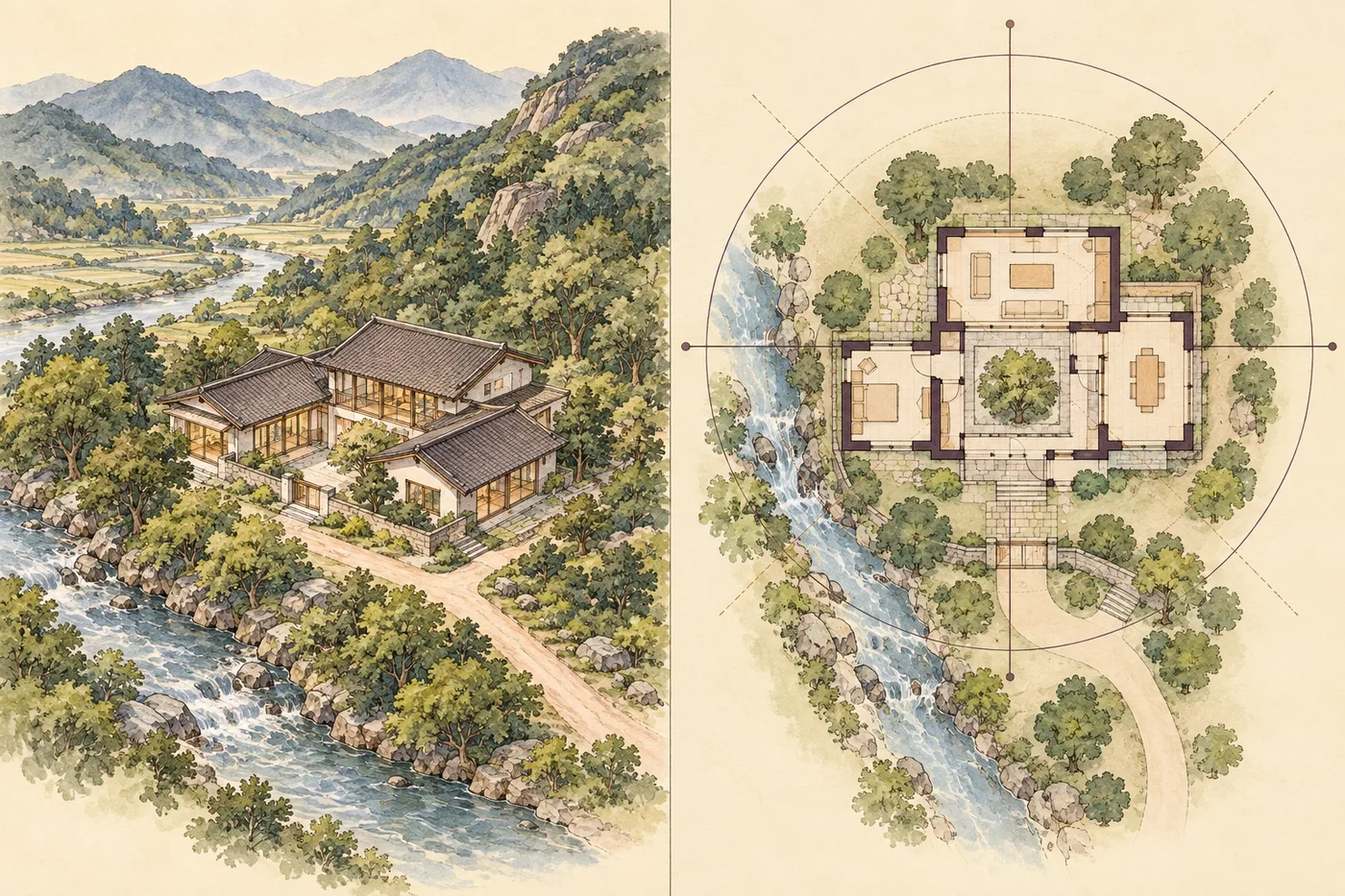
Form approaches attend to visible and felt relationships: landforms, shelter, approach, proportion, openings, circulation, and the position of a person within a site or room. At home scale, this can mean noticing whether a chair has support behind it, whether an entry is easy to understand, or whether a path repeatedly squeezes around furniture.
Classical landscape images such as mountain and water carry symbolic and environmental meanings. In contemporary interiors, they are sometimes translated into “support” and “movement.” Treat that translation as an adaptation, not proof that a wall literally produces fortune.
Compass traditions add direction and time
Compass schools use orientation together with cosmological systems such as yin–yang, the five phases, trigrams, and specialized formulas. Some methods incorporate a building’s facing direction and construction period; others relate directions to occupants or particular charts.
A generic article cannot perform those systems responsibly without defining the exact method and collecting accurate inputs. That is why FateQ will not declare one “lucky direction” for every reader or mix isolated compass formulas into a Form School walkthrough.
Use three filters for any recommendation
- Which school or adaptation is speaking? Look for a named method, not just “feng shui says.”
- What observable problem is being addressed? Glare, blocked movement, lack of privacy, or distraction can be checked directly.
- What are the constraints? Safety, accessibility, ventilation, building rules, budget, and the needs of everyone in the home come before symbolism.
What these guides mean by balance
Balance is not perfect symmetry or a room frozen in a magazine image. It is the workable relationship between rest and activity, openness and enclosure, brightness and shade, display and storage. The right balance changes with the activity and the household.
Make one reversible change at a time and observe it for several days. If moving a desk improves focus because the door is visible and glare is reduced, that is useful information. No extra claim about guaranteed success is required.