Public and shared rooms
Read seating and sightlines in a shared space
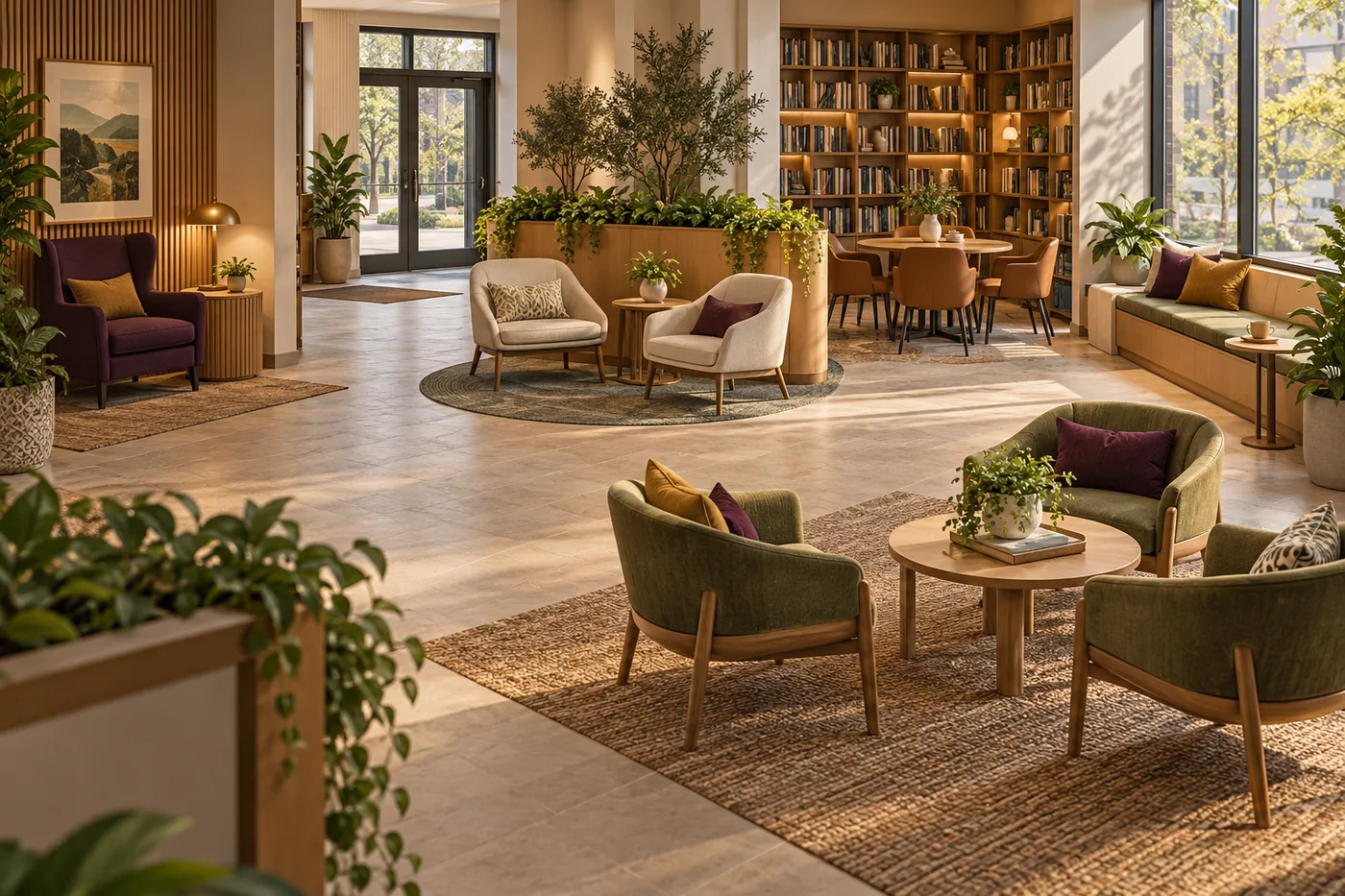
A waiting room, library lounge, community room, or shared living area cannot give every person one ideal “command position.” The better goal is a range of seats with legible routes, useful views, and different degrees of social exposure.
Map what each seat asks a person to manage
Begin before anyone sits down. Mark entrances, service counters, screens, windows, toilets, exits, and the paths staff or residents use most. Then occupy each seat for several minutes. What enters the field of view? What passes behind the body? What sound or glare becomes noticeable only after settling?
Form School language often values support behind a person and awareness of approach. In a shared room, treat those as variables rather than rules. A wall-backed corner may feel focused to one visitor and trapped to another. A central seat may feel exposed, or it may be the easiest place for someone using a mobility aid to join a group.
Separate clear sightlines from surveillance
Seeing an entrance can reduce surprise and help someone understand how the room works. It does not follow that every chair should face the door or that occupants should be visible from every angle. Continuous visibility can be tiring, especially where people wait, study, receive support, or hold private conversations.
Look for partial rather than total solutions: an angled chair that includes the entrance in peripheral vision, a low screen that defines a seat without hiding the route, or a table position that avoids direct eye contact with everyone who arrives. Do not use mirrors where they create glare, confusing movement, or an unwanted view of another person’s screen.
Offer edges, centers, and ways to opt in
One furniture arrangement rarely serves quiet waiting, informal conversation, focused work, and group activity equally well. Provide choices where possible: some seats near an edge, some facing another person, some with a longer view, and some that allow attention to remain private. Choice matters more than declaring a single position auspicious.
Environmental-behavior research is useful here as a separate line of evidence, not proof of feng shui. Studies of public-space enclosure and library seat selection suggest that spatial definition, visual connection, edges, and privacy can influence preference. Those findings are contextual: culture, task, crowding, and individual sensory needs can change what someone chooses.
Keep circulation out of the conversation zone
A route that cuts through a seating cluster repeatedly interrupts both movement and conversation. Shift the cluster, move a small table, or clarify the path with lighting and floor cues before adding partitions. Maintain wheelchair turning space, accessible routes, required exit widths, and staff sightlines determined by safety policy.
Watch what happens when bags, canes, strollers, or charging cables enter the room. A layout that works only when every surface is empty is not yet resolved. Storage and power access are part of the form because they determine where objects actually accumulate.
Use orientation cues without overfilling the room
A person should be able to tell where to enter, where to ask for help, and which seats are available without decoding a decorative scheme. A visible destination, consistent lighting, and a few distinct zones usually orient better than many signs or symbolic objects.
In a multipurpose room, movable furniture can be helpful only if its default arrangement is clear and someone is responsible for restoring it. Heavy “protective” furniture behind every chair may reduce flexibility and create barriers. Support can come from a wall, a high-backed seat, a planter at a safe distance, or simply enough space that traffic does not brush past.
Observe use before calling a layout finished
Record which seats fill first, which remain empty, where people move chairs, and where conversations block the path. Ask users rather than inferring discomfort from behavior alone: an unused seat may have glare, cold air, a poor view, a broken outlet, or no problem at all during the observation period.
Make one reversible change and compare the same time and activity on another day. The aim is not a room that controls behavior. It is a room that makes its options understandable and allows people to choose a workable degree of connection, privacy, and awareness.